


.png)

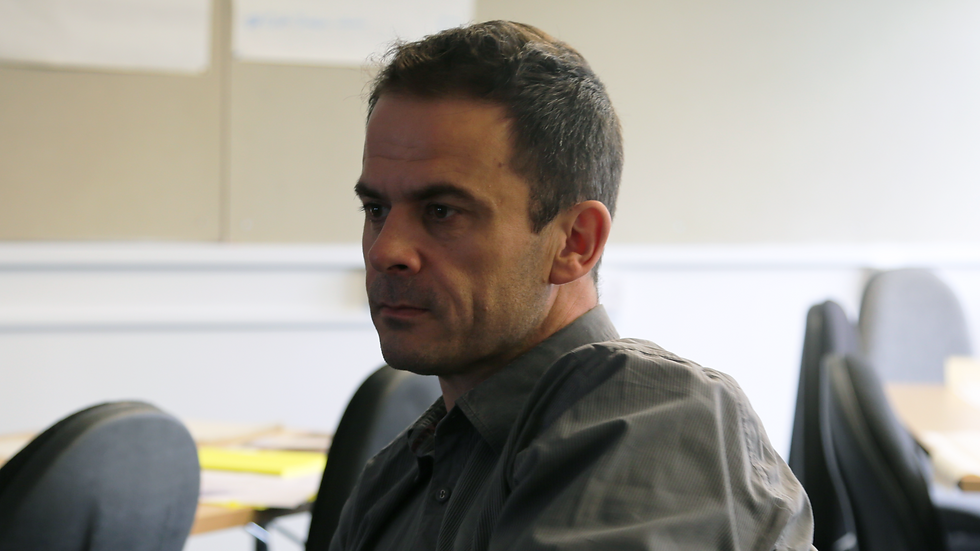
Questions With... Mike Pumford
- northernsongevent

- May 10, 2019
- 7 min read
Visual Communication lecturer and programme leader for Digital Photography Mike Pumford gives his recommendations for Northern artists, his favourite photographers, as well as an amusing story from his time working as a photographic restorer.

A: “How would you describe the event Northern Song?”
M: “Northern Song is part of the Experiential Learning Module which we run each year. The good thing about the Experiential Learning Module is its ability for students and staff to work together in more of an industry context rather than a formal lecture setting. Staff basically come out of the lecturer mode and go back into their industry role. This year is one of the first year where it has been quite prescribed, in terms of the title being ‘Northern’. I don’t think that it has been put like that to exclude anyone from the South but more to do with the locality of the University and ideas surrounding Northern Grit. It’s around the idea of the song as well, the music was produced by a student [Luke Kuppan], and the lyrics put together by Deputy Head Phil Potter.”
A: “What are your favourite artists at the moment?”
M: “My podcasts are quite varied at the minute. I read more than I listen to media online. At the moment I am reading a lot about esoteric symbolism - it’s sort of a lifelong interest. Manly P. Hall’s The Secret Teachings Of All Ages, which is one of the greatest books that has ever been written, is what I have been looking at right now. In terms of music I only ever listen to 80’s, because music ended in 1989 - I don’t know if you are aware of that. While friends were growing up and listening to INXS, U2 and fashionable bands like that I was still doing the Stock Aitken & Waterman thing as part of my softer side. Big fan of the 80’s. at the moment I have been listening to the Rocky IV soundtrack. Brilliant synthesizer tunes in there by Vince DiCola, because I do a lot of running and training and I don’t think there has been a better pump up soundtrack than the Rocky IV soundtrack, so I am revisiting the mid 1980’s with my choice of music. Radio tends to be The Greatest Hits - again focused on the 1980’s.”
A: “How would you describe Northern-ness?”
M: “It depends again what decade you were brought up in. I was brought up in the mid 70’s and 80’s where there was quite a restriction on funding for towns and cities in the North from the government at the time, which was later revealed in some papers. My experience of Northern-ness is (as the only way you can do is compare to the South) is an attitude surrounding the ‘Just get on with it irrespective of adversity or obstacles that are placed in front of you’. I think there is

an objective to achieve even in light of great challenge which is typically Northern because in my experience of being a Northern myself you don’t often have the resources to do it as well as you would like to so you make do with the best of what you have got. I think also when things get tough there is a certain tenacity in Norther-ness. People won’t lie down if something hits them and put them down - I am not saying this isn’t available in the South either. But the Northerners I know tend to be very tough people and irrespective of what puts them down they won’t stay down - they will just keep getting on. There is a toughness there but also a strong heart in the North as well, where people look out for each other, which is not always the case in most places. That is my experience in the North. How could I sum it up? Fists of steel, but a heart of gold.”
A: “Are there any pieces of work from students that have stuck with you?”
M: “At this time of year we have a lot of exhibition work with the experiential exhibition - it is difficult because it’s a sample of all the students work. A lot of the work will have been produced for presubscribed modules. I have liked some of the work to do with surreal and the uncanny over the years, not in any particular years. I have an interest in that sort of thing as well. This year seems to be more towards the Fine Art elements. In the third year exhibition there is plenty of abstract stuff, people dealing with lines, shape and form. But I also like some of the more obscure stuff - we have students doing fetishism and eroticism, people dealing with club scenes and pubs, documentary and some physco-geography as well. I don’t have a particular favourite piece of work that stands out because students tend to deal with similar themes year on year. But I do have a tendency to the uncanny and the surreal stuff, because that’s what I am like, I suppose.”
A: “Are there places in the North that you would recommend students go to?”
M: “Bradford, definitely. I like the art galleries in Liverpool. I am a big fan of the Tate, even the older galleries like the Williamson. Really great places that are free to get in. I have visited those galleries since I was young. They do have a solitude about them, you can go in them and just relax for a couple hours even though most people don’t spend long looking at a piece of work. I find galleries and their spaces in their own right interesting aside from the actual work in itself. But certainly check out the art galleries in Liverpool. Radio City is good as well - if you want to see how radio is broadcast from about 400 feet in the air then you have got Radio City Tower near St Johns Liverpool.”
A: “What is the craziest story you have from working in the industry?”
M: “I spent a number of years as a professional restorer in photographic retouching. We would have people bring in damaged photographs and asking us to do certain things with them. Two notable examples that I remember is one lady brought in her wedding photographs and they were beautifully shot but the marriage didn’t last particularly long, and she divorced from her first husband, and very quickly married her second husband. So she didn’t have to fork out paying three thousand pounds to have the shoot taken again, she basically brought in an image

of the new husband and asked me to Photoshop it on to the head of the old husband in the initial wedding shoot. Which was fine, but half the people in the initial wedding shoot had since died, so there was a bit of a temporal time issue with the picture, but she was happy with that.
“We also had people bring photographs in who don’t understand that photography is flat - even when we open an image in Photoshop, it’s just pixels on a screen. It is essentially a flat surface. We’ve had some people who’ve claimed that when we’ve processed their images that when they’ve pressed the shutter on the camera everything’s looked okay to them, but when the prints have come back, after they’ve been processed, they have broom handles sticking out of people’s backsides and things. So we had one customer who brought an image in with just that, somebody in a shot with a broom handle sticking out of their backside, and claimed that we’d put it there as part of our development process, and could we remove it.”
A: “What advice would you give to students who are currently trying to get in to the creative industry?”
M: “This is going to run counter to the subject that I work with, but we’re in a world now that is predominantly digital, and it’s very easy to allow the software to generate content in pretty much all of the mediums that we do within the media now. So what I would suggest, and this might appear a little but backwards, but bear with me - do not lose touch with the haptic aspects of what you do, or the analogue aspects of it. So if you’re interested in photography, try a traditional film camera. If you’re interested in the arts, try to get hold of a pencil and put your ideas down on paper. Try recording sound using old tape to see how it used to be done. The digital world that we’re in now is great, but the technologies have muted the requirement for students to use the full extent of their creativity and ability. Instead of solving problems from the ground up, what we often find is people go on Google and just get an answer. Over time, the more and more you depend on technology for your ideas, the less you use your own creative ability. Going into an industry, it’s more often than not you’re shown how to use the technology to do the job, rather than being able to use your own creativity to push things forward. I’d say, keep one foot in the present, but maybe place your other foot in the past to see how we got to this point, pre-digital. Because digital’s not real, it’s just a sample of the reality, which is actually analogue.”
A: “Are there any Northern artists that you like at the moment?”
M: “I’ve always been a fan, even though he’s changed his genre lately, of photographer Tom Wood, who actually is a visiting lecturer. He works at the university. Tom photographed a lot in the early 1980s on New Brighton and on the Wirral Peninsula, which is where I was brought up -

chances are I’m probably in a couple of his photographs. He used to photograph places which you don’t ordinarily have access to now, so shipyards and hospitals, those sorts of places where it’s really difficult to gain access to, places like that. But he’s recently started doing some landscape photographs as well. So Tom is a Northern photographer, local based, and he is connected to the university. I’ve always been a fan of his stuff, alongside Martin Powell, who also photographed a similar part of the world. I like the work of some of my colleagues as well. We’ve got photography programmes on Kingsway campus, as well as here in Warrington. But they’re the type of artist I like, the documentary and landscape stuff.”
A: “Are there any notable stories about students that you can remember?”
M: “Hundreds, but I’m not sure I’ll be allowed to tell you any of them. What I will say is, unless it’s unique to me, we often get emails off students, sometimes in the early hours of weekend mornings when we know that students have been drinking. They’ve summoned up a little bit of courage to say things in emails they wouldn’t normally say sober, to your face. That is sometimes a source of great amusement, so we tend not to answer the email straight away, but we’ve got some corkers stored away in our inboxes somewhere. By all means email us, but try to be sober, and perhaps not at the weekends either.”
To learn more about Mike and his role at the University Of Chester, click here.


Comments